Towner County Dog Registration Information
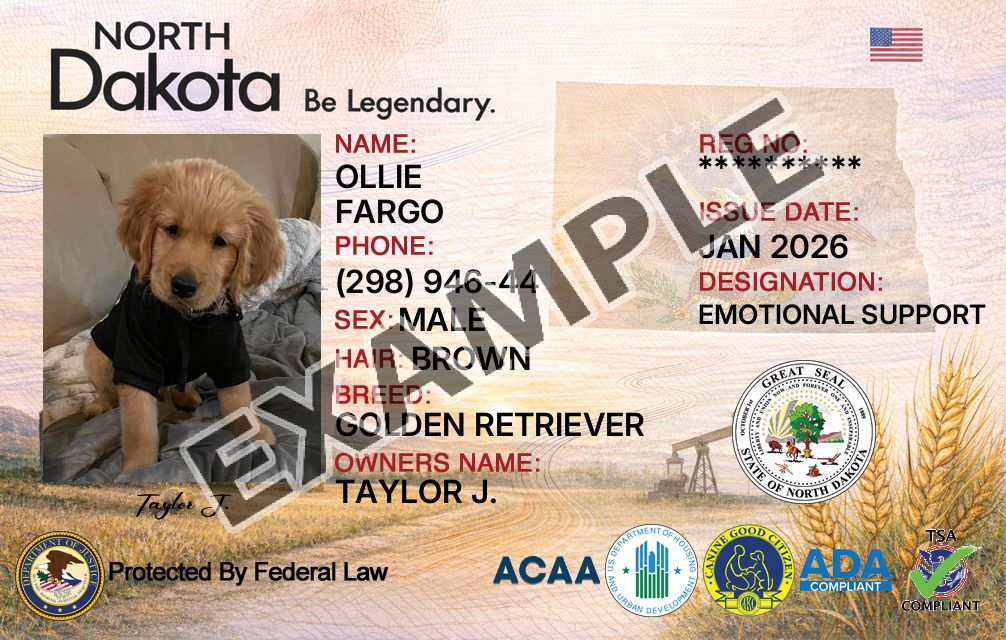
Service Dogs and Emotional Support Animals in Towner, North Dakota
If you’re asking, “where do I register my dog in Towner County, North Dakota for my service dog or emotional support dog,” the starting point is usually the same as it is for any pet: local dog licensing (sometimes called a dog license, dog tag, or rabies tag) is handled by local government, not by a universal federal registry. In Towner County, residents typically begin by contacting the county courthouse offices in Cando, and then confirm whether any city you live in (such as Cando or other municipalities) has additional local requirements.
Where to Register or License Your Dog in Towner County, North Dakota
The offices below are official government contacts serving Towner County residents. Dog licensing can be handled at the county level and/or may be addressed through a local city office depending on where you live inside the county. If you are unsure which office issues dog tags for your specific address, start with the county courthouse contact and ask for the correct licensing process for your city or township.
Towner County Auditor (Towner County Courthouse)
- Phone: (701) 968-4340 Ext 2001
- Email: mreimer@nd.gov
- Hours: Monday - Friday, 8:30am - 4:30pm
Towner County Sheriff’s Office (Towner County Courthouse)
- Phone: (701) 968-4350
- Email: townersh@nd.gov
- Hours: Monday - Friday, 8:30am - 4:30pm
City of Cando (City Office)
- Phone: (701) 968-3632
- Email: cityofcando@candond.com
Overview of Dog Licensing in Towner County, North Dakota
What “registering a dog” usually means locally
In many North Dakota communities, “registering” a dog refers to obtaining a local dog license (often a tag that attaches to a collar). The exact rules can vary by municipality. In practical terms, local licensing is commonly tied to rabies vaccination status and basic owner information (name, address, contact details) so an animal can be identified if it’s found at large.
County vs. city rules within Towner County
Towner County includes incorporated areas (like the City of Cando) and also rural township/unincorporated areas. Some licensing and animal control responsibilities may be handled through city offices inside city limits, while other parts of the county may rely on county offices or the sheriff’s office for enforcement. Because local practice can differ, the most reliable approach is to verify requirements with the official offices listed above for your specific address.
What You Need Before Registering a Dog
Common documentation for a dog license in Towner County, ND
While the exact checklist can vary by city or county procedure, most dog licensing requirements in North Dakota communities are straightforward. Be prepared to provide the following items when you apply for a dog license in Towner County, North Dakota:
- Proof of current rabies vaccination (rabies certificate from a licensed veterinarian)
- Dog description (breed, color, sex, approximate age)
- Owner information (name, physical address, phone)
- Any spay/neuter documentation (if fees differ for altered vs. unaltered dogs)
- Payment for the licensing fee (amount and accepted methods vary locally)
Rabies vaccination and why it’s commonly required
Many local licensing programs require proof of a current rabies vaccination as a condition of issuing a license/tag. Even when you’re licensing a service dog or an emotional support animal, the rabies documentation requirement (if applicable locally) generally still applies because it is tied to public health and animal control practices rather than disability status.
Steps to Register or License a Dog in Towner County, North Dakota
Step-by-step process (typical local workflow)
-
Confirm whether your address is inside city limits.
City residents may have city-specific animal ordinances; rural residents may follow a county-based process.
-
Gather rabies vaccination proof and dog details.
A current rabies certificate is commonly requested before a license/tag can be issued.
-
Contact the appropriate office to ask where licensing is issued.
Start with the Towner County Auditor at the courthouse if you’re unsure which office issues the dog license in your area.
-
Submit the application and fee (if required).
Ask about renewal timing, late fees, and whether multi-year licensing is available (if your local area offers it).
-
Attach the issued tag to your dog’s collar.
If a tag is issued, keep it on the dog when required by local rules (especially when off your property).
If you’re licensing a service dog or ESA
When you’re trying to “register” a service dog or emotional support dog, you’re typically dealing with two separate topics: (1) local dog licensing requirements, and (2) the animal’s legal status (service dog) or housing-related documentation (ESA). Local dog licensing is about local compliance (tag, rabies proof), while service/ESA status is governed by different laws and does not come from a single government registration database.
Service Dog Laws in Towner County, North Dakota
Service dog status vs. local dog license
A service dog is generally defined (under federal disability law) as a dog trained to perform specific tasks for a person with a disability. That status is different from a dog license in Towner County, North Dakota. A dog license is a local requirement that may apply to dogs living in a given city or county, regardless of whether the dog is a pet or a working service animal.
No single official federal registry
There is no one universal federal government registry where service dogs are “registered” for public access rights. In day-to-day life, what matters legally is whether the dog is trained to perform tasks for a disability and whether the handler meets the legal definition of a person with a disability. Local licensing (if required) is still handled through local government offices.
Practical tips for Towner County residents with service dogs
- Keep rabies vaccination documentation accessible in case it is needed to obtain or renew a local dog license/tag.
- Ask the licensing office whether any local fee exemptions or special tags exist for service dogs (not all areas offer them).
- If you live inside city limits, confirm whether the city has additional animal rules (leash requirements, at-large rules, nuisance ordinances) that still apply to service dogs in public.
Emotional Support Animal Rules in Towner County, North Dakota
What an emotional support animal (ESA) is (and isn’t)
An emotional support animal is generally an animal that provides comfort by its presence and may be recognized in certain housing contexts. An ESA is not the same as a service dog, and ESAs do not have the same public access rights as service dogs. Like any other dog, an ESA may still need a local dog license in Towner County, North Dakota (and proof of rabies vaccination may be required).
No universal ESA “registration”
Similar to service dogs, there is not a single official government registry that you must use to “register” an emotional support dog. For most people, the relevant documentation is tied to housing needs and is separate from local licensing.
How ESA paperwork relates to dog licensing
Local licensing offices typically focus on public health and identification (rabies proof, owner contact information, fees). ESA documentation usually does not replace local dog licensing requirements. If a local office asks for rabies proof to issue a tag, you should be prepared to provide that standard documentation even if the dog is an ESA.
Dog License vs. Service Dog vs. Emotional Support Animal (Comparison)
| Category | Dog License (Local Tag) | Service Dog | Emotional Support Animal (ESA) |
|---|---|---|---|
| What it is | Local licensing/identification program (often includes a tag) for dogs in a city/county. | A dog trained to perform tasks for a person with a disability. | An animal that provides emotional comfort; most relevant in housing contexts. |
| Who issues it | Local government office (county/city) that handles licensing and animal rules. | No single agency “issues” service dog status; it depends on training and legal definition. | No single agency “issues” ESA status; documentation is typically used for housing needs. |
| Common proof requested | Rabies vaccination certificate; owner contact/address; possibly spay/neuter info; fee payment. | Task training and handler’s need (not a universal registration card); may still need local rabies proof for licensing. | Housing-related documentation may be requested by housing providers; may still need local rabies proof for licensing. |
| Public access | Not applicable; a license is not a public access credential. | Generally allowed in many public places where pets are not. | Does not automatically grant public access where pets are not allowed. |
| Applies in Towner County, ND? | Possibly required depending on city/county rules; verify with offices in Cando. | Service dog laws apply everywhere, but local licensing may still apply. | ESA concepts may apply in housing; local licensing may still apply. |
Frequently Asked Questions
Where do I register a dog in Towner County, North Dakota?
Start with the Towner County Courthouse offices in Cando. If you live inside Cando city limits (or another incorporated area), you should also confirm whether the city office has additional dog licensing requirements or a city-issued tag. See the “Where to Register or License Your Dog in Towner County, North Dakota” section for verified office contacts.
Do service dogs need a dog license in Towner County, ND?
Service dogs may still need to comply with local dog licensing requirements (if your city/county requires a dog license). Service dog status is different from a dog license, and a local licensing tag is not the same thing as service dog authorization.
Do emotional support dogs need to be licensed locally?
Often, yes. An emotional support animal is not automatically exempt from local rules about dog licensing, rabies vaccinations, leashing, or at-large restrictions. If you need an animal control dog license in Towner County, North Dakota, the licensing office will usually focus on rabies proof and owner information.
What proof of vaccines is typically required?
Many local programs require proof of current rabies vaccination to issue or renew a dog license/tag. If you don’t have your rabies certificate, contact your veterinarian to obtain a copy before you apply.
I live outside Cando. Which rules apply to me?
If you live outside city limits, your area may follow county-level rules or township practices, and enforcement may involve the sheriff’s office. Because local requirements can vary, contact the Towner County Auditor at the courthouse to confirm where to register a dog in Towner County, North Dakota for your exact address.
Register A Dog In Other North Dakota Counties
Select your county below to get started with your dog’s ID card. Requirements and license designs may vary by county, so choose your location to see the correct options and complete your pup’s registration.
- Adams County Dog Registration
- Barnes County Dog Registration
- Benson County Dog Registration
- Billings County Dog Registration
- Bottineau County Dog Registration
- Bowman County Dog Registration
- Burke County Dog Registration
- Burleigh County Dog Registration
- Cass County Dog Registration
- Cavalier County Dog Registration
- Dickey County Dog Registration
- Divide County Dog Registration
- Dunn County Dog Registration
- Eddy County Dog Registration
- Emmons County Dog Registration
- Foster County Dog Registration
- Golden Valley County Dog Registration
- Grand Forks County Dog Registration
- Grant County Dog Registration
- Griggs County Dog Registration
- Hettinger County Dog Registration
- Kidder County Dog Registration
- LaMoure County Dog Registration
- Logan County Dog Registration
- McHenry County Dog Registration
- McIntosh County Dog Registration
- McKenzie County Dog Registration
- McLean County Dog Registration
- Mercer County Dog Registration
- Morton County Dog Registration
- Mountrail County Dog Registration
- Nelson County Dog Registration
- Oliver County Dog Registration
- Pembina County Dog Registration
- Pierce County Dog Registration
- Ramsey County Dog Registration
- Ransom County Dog Registration
- Renville County Dog Registration
- Richland County Dog Registration
- Rolette County Dog Registration
- Sargent County Dog Registration
- Sheridan County Dog Registration
- Sioux County Dog Registration
- Slope County Dog Registration
- Stark County Dog Registration
- Steele County Dog Registration
- Stutsman County Dog Registration
- Traill County Dog Registration
- Walsh County Dog Registration
- Ward County Dog Registration
- Wells County Dog Registration
- Williams County Dog Registration